Aotearoa AI Hackathon Festival 2026 — AUT City Campus
Two-Day AI Hackathon
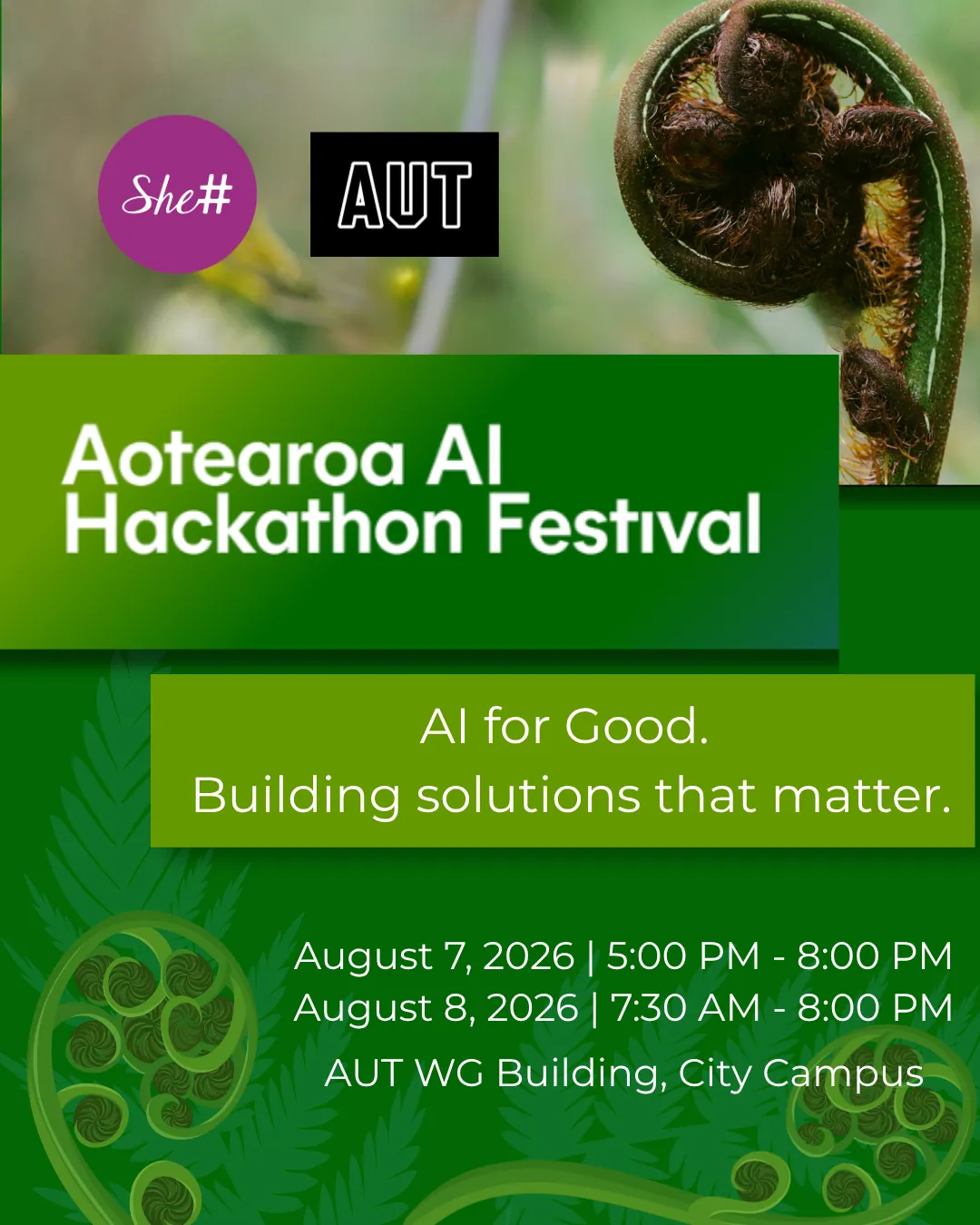
About this event
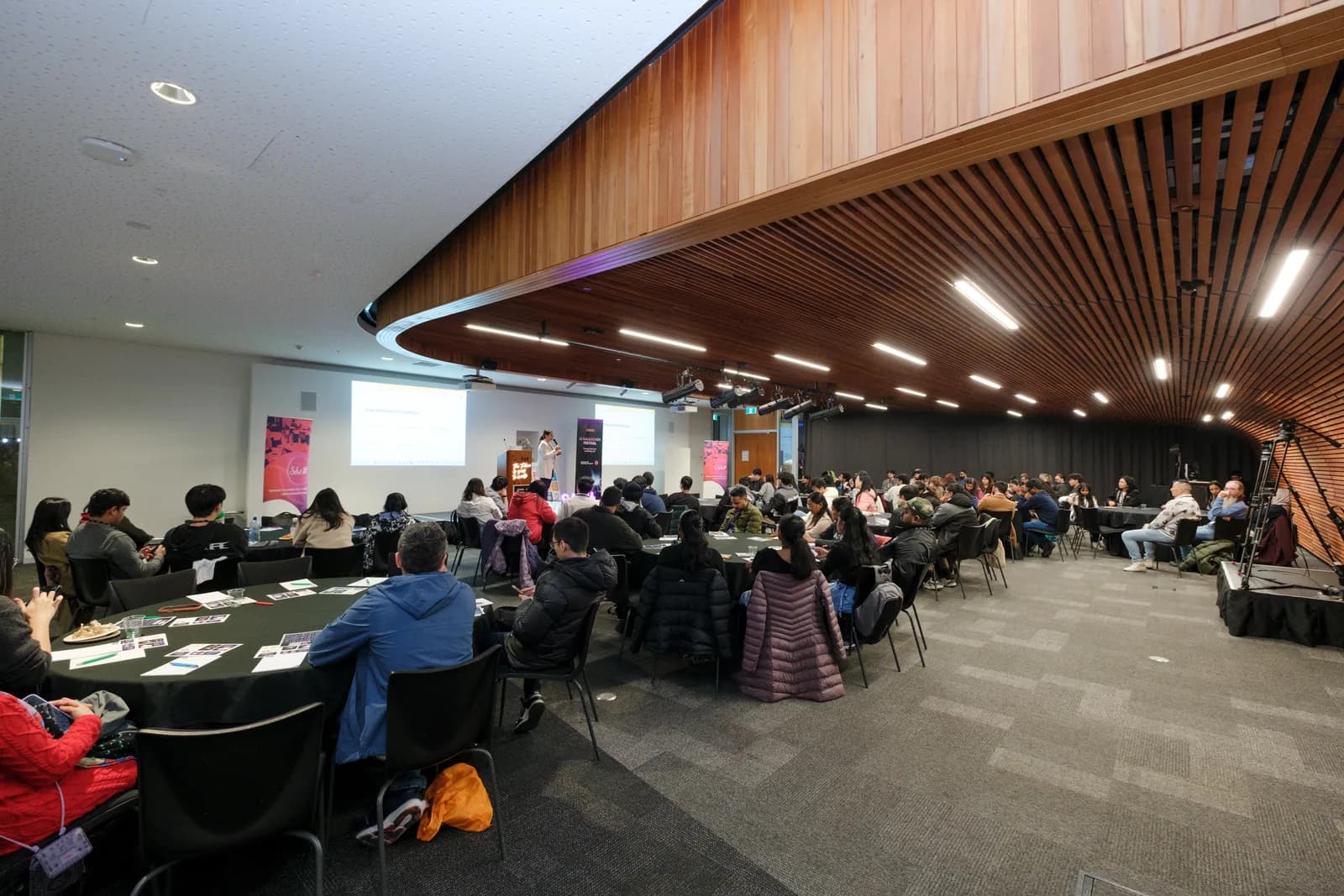
Twelve teams spent Friday evening 7 August and all of Saturday 8 August in the Sir Paul Reeves Building at AUT City Campus. On Saturday afternoon each team had five minutes in WG308 in front of a local judging panel: kailine took the venue prize, with kaitiakidata and kpi-kaitiaki-positive-impact as runners-up. The winning pitch went on to national judging, and the national finalists pitch at the Aotearoa AI Summit in Wellington on 8–9 September. Around a third of the participants had never been to a hackathon before, and mentors from AUT, She Sharp, Fisher & Paykel Healthcare and Southern Cross Health Society worked alongside the teams across both days.
The Aotearoa AI Hackathon Festival is a nationwide, multi-venue hackathon held across Aotearoa New Zealand. She Sharp, Auckland University of Technology (AUT) with the AI Forum brought the festival to AUT's City Campus for a two-day, in-person event on 7–8 August 2026.
Working in teams, participants created AI-enabled solutions to real-world challenges aligned to five UN Sustainable Development Goals. Day one focused on team formation, problem definition, and building; day two on refining solutions and pitching to a local judging panel.
Each venue selected a winning team whose pitch advances to national judging, and four national finalists have been invited to pitch live at the Aotearoa AI Summit on 8–9 September 2026 in Wellington, where the Summit audience votes for the overall winner. Experience level was no barrier — around a third of participants were new to hackathons — and mentors from AUT, She Sharp, Fisher & Paykel Healthcare, Southern Cross Health Society and other New Zealand tech organisations supported teams throughout.
Free online pre-event training ran throughout July to help teams build stronger ideas, prototypes and pitches. The festival is about building practical AI capability, encouraging responsible and ethical AI use, fostering collaboration across regions and sectors, and showcasing innovative, impact-driven ideas.
Team Kai Line — National Finalist at the Aotearoa AI Summit
Team Kai Line, the winning team at the AUT City Campus venue, has been selected as one of four national finalists to present on stage at the Aotearoa AI Summit in Wellington.
In under 48 hours the team built a service that makes grocery access effortless for people in need through a single phone call, enhancing digital accessibility for all communities. Congratulations to Sabrina Teoh, Nima Hosseini, Homayoon Zarshenas, Felix Lie and Jimmy Lin.
Festival Recap — AUT City Campus
Highlights Reel
Two-Day Format
- Day 1 (Friday 7 August) — Welcome, health & safety briefing, introduction to the hackathon themes, team formation, and the build begins, with ongoing mentor and technical support.
- Day 2 (Saturday 8 August) — Continued building, pitch practice, final submissions, live 5-minute pitches to the local judging panel, and announcement of the venue winner.
- Venue winners advance to national judging; four national finalists pitch at the Aotearoa AI Summit on 8–9 September 2026 in Wellington.
Day 1 Schedule — Friday 7 August
- 5:00–5:30pm — Registration, guest arrival & networking + dinner
- 5:30–5:40pm — Event opening: karakia, welcome to AUT, health & safety briefing
- 5:40–5:50pm — She Sharp introduction
- 5:50–6:10pm — Keynote speaker session
- 6:10–6:50pm — Team forming
- 6:50–7:05pm — Overview of day two
- 7:05–7:15pm — Problems to solve, requirements & judging criteria
- 7:15–7:20pm — Fisher & Paykel Healthcare on their two challenge briefs
- 7:20–7:30pm — Mentor introductions
- 7:30–7:35pm — Group photo
- 7:35–8:00pm — Team strategy planning
- 8:00pm — Close of day one
Day 2 Schedule — Saturday 8 August
- 7:30–8:00am — Arrival, coffee & tea
- 8:00–8:10am — Day two opening + team workspaces
- 8:10am–12:15pm — Team build with mentor support (pitch prep from 10:00am)
- 12:15–1:00pm — Lunch
- 1:00–1:15pm — Prepare for pitch practice
- 1:15–2:00pm — Pitch practice with mentors
- 2:00–3:00pm — Final pitch updates
- 3:00–3:30pm — Slides to She Sharp, judges arrive & judge briefing
- 3:00–3:15pm — Afternoon tea (grab and go)
- 3:15–4:00pm — Tech check with the teams
- 4:00–6:30pm — Final presentations to the judging panel
- 6:30–7:00pm — Judges' deliberation + networking + dinner
- 7:00–7:30pm — Awards announcement
- 7:30pm — Closing & group photo
Forming Your Team
- Register as an individual and join a team on the first morning, or register with a team you have already formed — either works.
- We recommend teams of three to six members. A hackathon is a safe space for people from different skill sets and backgrounds to gather around a problem, and a good mix — technical, design, domain and commercial — consistently produces stronger solutions.
- Mentors are there from the start to help people find each other and to check that teams are the right size and balanced.
- On day two, pitch practice starts around midday. Most teams split at this point — some keep building towards the solution, others start building the pitch.
- The team comes back together for the 30 minutes between the end of the hack and the start of pitching.
How Mentors Help You
- Technical Experts — answer complex technical questions, sense-check your design and suggest alternatives, with deep expertise in AI and data. They will not build it for you, but they will show you where it is going wrong.
- Subject Matter Experts — know the problem domain and can tell you whether your solution would genuinely work for the people it is meant to help.
- Business Experts — check in often on team dynamics, problem framing and the story you are telling, and help you shape a pitch that lands in five minutes.
- Mentors are available across both days. Ask early and ask often — that is what they are here for.
How Teams Are Judged
- Each venue has a panel of three to four judges: a host representative, a sponsor or business representative, and a member of the AI Forum Executive Council.
- Each team delivers a live 5-minute pitch to the panel, followed by a short Q&A with the judges.
- Judges score four equally-weighted criteria (1–5 each):
- Inspiration — a clearly defined problem, a solution that solves it, and real impact for New Zealand and the world.
- Technology — the solution must use AI; demonstrate feasibility, engineering quality, and how the technology solves the problem (a working prototype is highly recommended).
- Design & Innovation — originality, user experience, and inventive use of technology.
- Presentation — a clear, creative pitch that addresses the problem and answers judges' questions within the time limit.
- Every venue in the festival scores against the same scorecard. The TAIAO scorecard weights all four categories equally; the Technical Brilliance scorecard is weighted towards Technology.
- Every pitch is recorded. Each venue announces its own winner on the day, and that winning pitch goes forward to the national judging panel.
- All judging panel decisions are final.
- An optional pitch deck template is available in the Community Hub as a guide.
What the Judges Look For
- Judges have very little time to absorb an idea that may be completely unfamiliar to them. Judges from the last five years of the festival advise focusing on three things:
- Does it solve an important UN Sustainable Development Goal problem?
- Is the solution feasible and achievable?
- Will it make an impact?
- And for the Technical Brilliance prize, a fourth: does it demonstrate strong technical thinking?
National Judging Panel
The national panel watches every venue's winning pitch video, scores it against the same scorecards used at each venue, and selects the one winner who pitches on stage at the Aotearoa AI Summit. The same panel awards the AI Technical Brilliance Prize, which can go to any venue winner — not only the national winner.
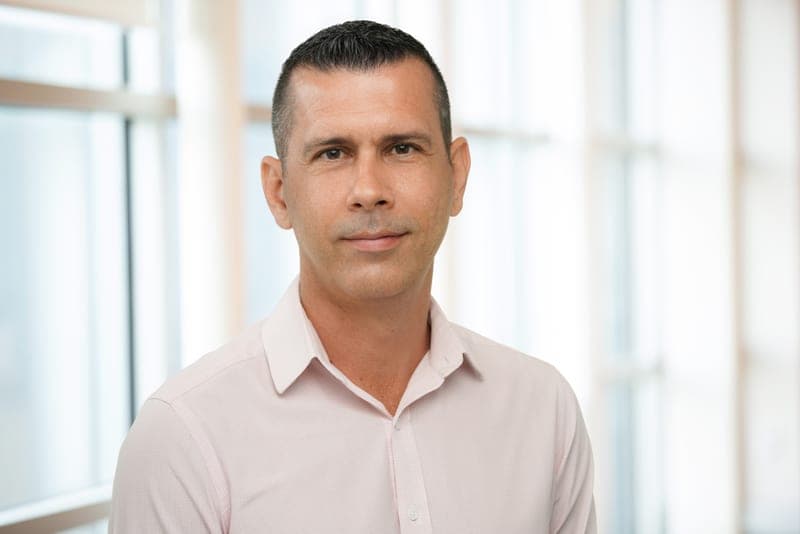
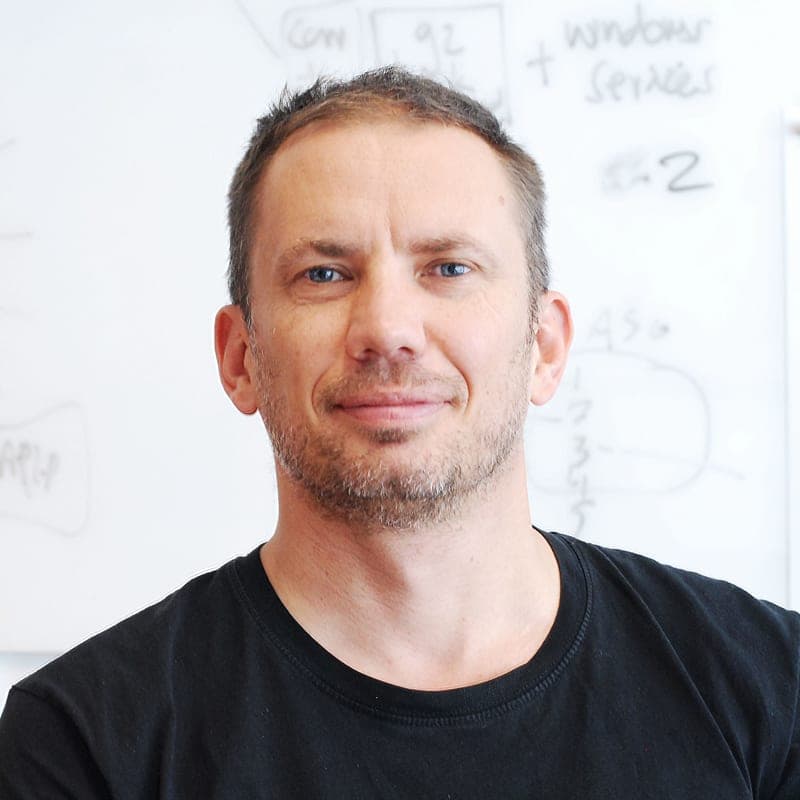
Albert Bifet (University of Waikato) chairs the panel and David Knox (Topologic) is deputy chair. They are joined by Prof Yun Sing Koh and Prof Karin Bryan (University of Auckland), Nicholas Fourie (Fisher & Paykel Healthcare), Dr Mahsa McCauley (AUT, Chair of AI Forum New Zealand), Dr Karaitiana Taiuru (AI, data and emerging technology ethics, governance and research; Chair of Kāhui Māori), Shivonne Llondt (AWS) and Nicola Voice (Sustainability Lead, Woolworths New Zealand).
Dr Mahsa McCauley and Nicholas Fourie sit on both the AUT City Campus venue panel and the national panel.
Your 5-Minute Pitch, Section by Section
- Connect — 30 seconds. Who are you and what is your passion? Think of it as speed dating: you get one first impression.
- Problem to Solve — 1 minute. What problem are you solving, and why should anyone care? Who or what does it impact? Humanise it with a short story, and back it with data — this is an AI hack, after all.
- Your Big Idea — 2 minutes. How does your innovation solve the problem, and how does it meet the brief? Show us your prototype — high-fidelity or click-through slideware is fine.
- Future Impact — 1.5 minutes. What will your innovation change? What do you need to make it work? And what could it mean for the future?
- Describe the problem you actually ended up solving — it is not always the one you set out to solve.
The Challenge — Five Real-World Themes
- This year's theme is AI for Good — Building Solutions that Matter. Every solution should tackle a real-world challenge aligned to one of the five UN Sustainable Development Goal categories: People, Planet, Prosperity, Peace or Partnership.
- Tackling food insecurity in a food-exporting nation
- Enhancing digital accessibility for all communities
- Upskilling the workforce for an AI-driven future
- Fostering cross-border, cross-sector collaboration
- Honouring indigenous environmental custodianship (kaitiakitanga)
How the National Festival Works
The Aotearoa AI Hackathon Festival runs as a series of two-day hackathons hosted at venues across Aotearoa New Zealand between 3 and 10 August 2026 — each venue picks its own two days within that window.
Every venue records its team pitches and selects a local winner. A national judging panel then reviews the winning pitches and selects the finalists.
Four national finalists are invited to pitch live at the Aotearoa AI Summit on 8–9 September 2026 in Wellington, where the Summit audience votes for the winning solution and the award-winning team is announced.
Prizes & Awards
- Every venue winning team: $250
- Four national finalists invited to pitch at the Aotearoa AI Summit 2026
- National — TAIAO Prize (Summit audience vote): $1,000
- National — Technical Brilliance (national judging panel): $1,000
- Prizes supported by AWS and provided via AI Forum New Zealand
- Individual venues may offer additional prizes and categories
Free Training — Seen Ventures Hack Fit Series
- Free for all participants — 60-minute online sessions throughout July, 4:00–5:00pm NZST, designed to help you build stronger ideas, prototypes and pitches with practical tools across business, design and technology.
- Become Hack Fit
- Tell the Story with AI
- Design Thinking with AI
- Agentic Workflows
- Making Sense of Data
- Creative Tech Booster
- Creating Multi-Modal AI Experiences
- Register via the AUT City Campus Community Hub : https://tnz-ecosystem-hub.circle.so/c/ai-hackathon-festival-2026/aut-city-campus
Featured Problem: Food Waste
One of this year's featured problems is supported by Woolworths New Zealand alongside Kai Commitment, focused on reducing food waste across the supply chain — from farm to fork.
Explore how AI can help identify waste, fill data gaps, support optimisation and better collaboration across the food system.
Featured Problem — F&P Healthcare: Facilities Helpdesk Agent
Fisher & Paykel Healthcare, a sponsor of the festival, has put forward a process optimisation challenge: design an AI agent for its Facilities Helpdesk — the single point of contact for maintenance and facilities service requests across the organisation.
Today the experience places unnecessary effort on both the people raising requests and the Facilities team. Intake, prioritisation, escalation guidance and status communication all rely on manual steps, separate process knowledge and email follow-up. The result is inconsistent processes that sit outside the tools staff use day to day, incomplete request data, no real-time visibility for the requestor, and sub-optimal escalation responses.
The opportunity is to create a more employee-friendly front door for Facilities requests: guiding staff through structured intake in plain language — in their own words — applying the existing priority process consistently, surfacing escalation guidance at the right moment, and keeping requestors informed throughout.
How it matches the UN Sustainable Development Goals: being inclusive means every employee can engage in their own language and has equal visibility of progress (SDGs 8, 9 and 10); removing wasted effort, resources and rework makes the process more sustainable (SDG 12); and F&P Healthcare's solutions support good health and well-being (SDG 3).
F&P frames this as "Care by Design" — good people doing good work with intent. When reviewing and judging pitches, F&P is looking for teams whose design is genuinely underpinned by that Culture of Care, and which centre people and process ahead of technology. Watch the video below to see how F&P works.
Care by Design — Fisher & Paykel Healthcare
Featured Problem — F&P Healthcare: Restoration Intelligence
Fisher & Paykel Healthcare, a sponsor of the festival, has put forward a second challenge — this one from its sustainability team: Restoration Intelligence, turning drone data into environmental insights. As part of developing F&P's new Karaka campus, the team is restoring the Oiroa Stream and surrounding wetlands, where employees, families and community members have planted more than 3,000 native plants across 22 species since 2023 to improve biodiversity, water quality, habitat connectivity and climate resilience.
Ecological restoration projects increasingly use drones to collect imagery and video, but measuring restoration outcomes still relies on specialist ecological and Geographic Information System (GIS) expertise. As a result, monitoring is often manual, expensive, infrequent and hard to scale, requiring extensive fieldwork in difficult terrain.
The challenge is to build an AI-powered restoration monitoring solution that automates the analysis of periodic drone imagery — annual surveys collected over the 20+ year lifetime of a landscape restoration project — along with drone video, to quantify ecological outcomes and generate actionable insights. Where available, it should integrate additional data such as biodiversity records, GIS layers and historical monitoring datasets, reducing reliance on manual assessment, specialist expertise and fragmented tools.
Teams are encouraged to address as many of the restoration monitoring metrics below as they choose — they do not need to tackle them all, since solutions may be limited by the availability of open-source data and tools. In the absence of drone images, large-scale restoration projects such as Matuku Link (Te Henga), Waikereru Ecosanctuary (Gisborne) and Hinewai Reserve (Akaroa) may offer suitable proxy and historical satellite imagery for training and testing.
How it matches the UN Sustainable Development Goals: the project supports SDG 15 – Life on Land through improved monitoring of biodiversity and restoration outcomes, and SDG 12 – Responsible Consumption and Production through more efficient, better-informed stewardship of natural resources. It aligns with F&P Healthcare's values of Innovation and Life and its intention to create a positive, lasting impact on society and the environment.
What to Measure — Restoration Metrics
- Tree survival (%) — planting success and areas of plant mortality
- Native species richness — biodiversity and diversity of the native plant community
- Keystone species tracking (e.g. Kahikatea, Kauri, Pukatea) — establishment and survival of priority species
- Natural regeneration density — self-seeded recovery and ecosystem self-sustainability
- Native canopy cover (%) — vegetation establishment and habitat development
- Exotic plant cover (%) and weed cover (%) — non-native competition and invasive pressure
- Riparian shade cover (%) — stream shading that supports water quality and temperature
- Time-series imagery and change detection — visual storytelling of restoration progress over time
Featured Problem — My Life My Voice: Accessible UI Generation
My Life My Voice has submitted a featured problem on accessible user interface (UI) generation for developers. Millions of people with disabilities encounter barriers every day because the apps and digital tools they rely on were not built accessibly. The Web Content Accessibility Guidelines (WCAG) exist precisely to address this — yet compliance rates remain persistently low.
The bottleneck is not developer intent; it is workflow. Accessibility checking is manual, happens late in the build process, and sits outside the tools developers actually use. When it does exist, it audits what is already broken rather than preventing the problem at the point of creation.
The opportunity is to create an AI-powered tool that embeds accessibility support directly into the development workflow — enabling developers to check UI components against WCAG criteria in real time, and to generate accessible layout options at the point of design rather than after the fact. Unlike existing checkers (such as Microsoft's accessibility tools), the focus here is on generative support: producing accessible options, not just flagging inaccessible ones.
Why AI, why now: current AI coding tools optimise for speed and functionality, and none meaningfully optimise for accessibility. An AI layer that understands accessibility standards could shift accessibility from an audit task to a design default — making inclusive UI the path of least resistance for any developer, regardless of their prior knowledge of disability or accessibility standards.
How it matches the UN Sustainable Development Goals: SDG 4 – Quality Education, SDG 8 – Decent Work and Economic Growth, and SDG 10 – Reduced Inequalities. Designing user interfaces that cater to people of all abilities increases opportunities for education and economic contribution, and reduces barriers to access and therefore inequalities.
Who Benefits — Accessible UI Generation
- Disabled people who currently encounter inaccessible digital products daily
- Developers who want to build inclusively but lack embedded, standards-based support to do so
- Businesses and app developers losing disabled customers — and their revenue — because their products cannot be accessed
- Organisations navigating increasing legal and regulatory pressure around digital accessibility
Accessible UI Generation — My Life My Voice
Meet the Event AI Assistant
She Sharp has built an AI voice assistant for this year's hackathon, so you can ask about the schedule, venue, challenges, judging criteria and logistics in your own words and get an answer straight away.
AI Assistant Demo
2026 Venues
- Auckland — Mission Ready, 5–6 August (Onehunga)
- Auckland — Unitec + Seen Ventures, 6–8 August (Mt Albert)
- Auckland — AUT + She Sharp, 7–8 August, CBD (this event)
- Auckland — AUT + Tū Ātea, 7–8 August (Manukau)
- Auckland — academyEX, 8–9 August
- Waikato — Te Ipu o Te Mahara | Artificial Intelligence Institute, 6–7 August
- Wellington — Amazon Web Services (AWS), 6–7 August
- Christchurch — EPIC Innovation + Canterbury Tech, 6–7 August
- Dunedin — Business South + University of Otago, 8–9 August
Why Attend
- Build practical, hands-on AI capability on real-world problems
- Collaborate in diverse teams (3–6 people) with mentor and technical support
- Learn responsible and ethical AI practices
- Access free pre-event training to strengthen your idea and pitch
- Pitch your solution and compete to represent your venue at national judging
- Open to all experience levels — beginners are welcome
Live Q&A Sessions
- The first live Q&A session was held on Wednesday 1 July 2026, 12:00–1:00pm NZST — mentors and venue hosts covered rules of engagement, ideas, technology and how to take part.
- A second live Q&A session followed on Wednesday 15 July 2026, with Fisher & Paykel Healthcare walking through their challenge brief and past winners sharing their hackathon journey.
- Q&A Session 1 (1 July 2026) : https://tnz-ecosystem-hub.circle.so/c/ai-hackathon-festival-2026/q-a-session-1
- Future Q&A dates, session recordings and the Ask a Question tab are all published in the AUT City Campus Community Hub — join for updates through July and August.
Registration
Registration for the AUT City Campus venue closed on 20 July 2026 — in-person capacity at AUT City Campus is limited to 100 participants.
Registered participants — join the AUT City Campus Community Hub and the participant Discord for the latest updates, Q&A recordings and the pitch deck template.
Other festival venues and dates are listed at aihackathon.nz.
Supporters & Venue Hosts
- Mission Ready, Unitec, Seen Ventures, academyEX, AUT, Tū Ātea, She Sharp
- Te Ipu o Te Mahara | Artificial Intelligence Institute, Amazon Web Services (AWS)
- EPIC Innovation, Canterbury Tech, Tech New Zealand
- Woolworths New Zealand and Kai Commitment (Food Waste featured problem partners)
- Fisher & Paykel Healthcare (Facilities Helpdesk Agent and Restoration Intelligence featured problems)
- My Life My Voice (Accessible UI Generation featured problem)
This event has ended
Time & location
AUT City Campus
55 Wellesley Street East, Auckland CBD, Auckland 1010
Auckland
Event poster
Keynote Speaker

Meet the Judges


Meet the Mentors












Event sponsors
Powered by our partners


Thanks for the support
A taste of the event
Photography by VISIONWORKS
About the Festival — AI for Good
Aotearoa AI Hackathon Festival is a nationwide kaupapa built around one idea: AI for good — building solutions that matter. Over an intense weekend, diverse teams turn real-world challenges into working, AI-enabled prototypes.
Hackathons are a safe space for a wide range of people to unite and solve problems. Building a team with a variety of skills — not just coding — is the surest path to a strong pitch.

Part of a Nationwide Festival
The AUT City Campus event is one of several venues running across the country during the festival window in early August 2026.
Venues span Auckland, Waikato, Wellington, Christchurch and Dunedin — see the 2026 Venues list above for the host and dates at each location.
Featured Problem — Food Waste
One of this year's featured problems is supported by Woolworths New Zealand alongside Kai Commitment, focused on reducing food waste across the supply chain — from farm to fork.
Explore how AI can help identify waste, fill data gaps, support optimisation and better collaboration across the food system. Watch the problem statement video and related resources in the Community Hub.
Featured Problem — F&P Healthcare
Festival sponsor Fisher & Paykel Healthcare has put forward a process optimisation challenge: an AI agent that gives staff a friendlier front door to the Facilities Helpdesk, guiding requests in plain language, applying the existing priority process consistently, and keeping people informed as their request progresses.
F&P calls this Care by Design — good people doing good work with intent — and is looking for teams whose solutions are underpinned by that Culture of Care. The full challenge brief and Q&A recordings are published in the Community Hub.
Featured Problem — F&P Restoration Intelligence
Fisher & Paykel Healthcare's sustainability team has added a second challenge: Restoration Intelligence — turning drone data into environmental insights. At F&P's new Karaka campus, volunteers have planted 3,000+ native plants to restore the Oiroa Stream and wetlands, and the team wants a better way to measure how that restoration is progressing.
The challenge is to build an AI solution that analyses periodic drone imagery and video to automatically track ecological outcomes — tree survival, species richness, canopy cover, weed spread, riparian shade and more — reducing reliance on manual, specialist monitoring. It aligns with SDG 15 (Life on Land) and SDG 12 (Responsible Consumption and Production).
Featured Problem — Accessible UI Generation
My Life My Voice has submitted a featured problem on accessible UI generation for developers. WCAG standards exist, but compliance stays low because accessibility checking is manual, happens late, and sits outside the tools developers actually use — auditing what is already broken instead of preventing it at the point of creation.
The challenge is to build an AI-powered tool that checks UI components against WCAG criteria in real time and generates accessible layout options at design time — producing accessible options, not just flagging inaccessible ones. It aligns with SDG 4 (Quality Education), SDG 8 (Decent Work and Economic Growth) and SDG 10 (Reduced Inequalities).
Prepare Your Pitch
On day two, each team delivers a live 5-minute pitch to the local judging panel, followed by a short Q&A. Venue winners advance to national judging, and the four national finalists pitch at the Aotearoa AI Summit on 8–9 September 2026 at Tākina in Wellington, where the Summit audience votes for the overall winner.
Download the official pitch deck template from the Community Hub to structure your solution, impact and next steps — and see “Your 5-Minute Pitch, Section by Section” above for how the five minutes are meant to break down.
Live Q&A & Community Hub
The AUT City Campus Community Hub is your central hub for everything leading up to the hackathon — Q&A session recordings, free training registration, the pitch deck template, and the Ask a Question tab for direct support from mentors and venue hosts.
Live Q&A sessions were held on 1 July and 15 July 2026, and both recordings are available in the Hub. Further session dates and resources are published there as they are announced.
About the Venue
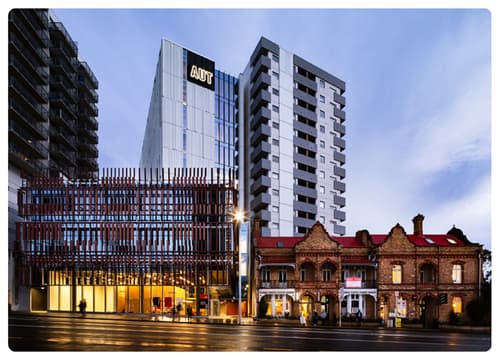
The event is hosted in person at AUT City Campus, 55 Wellesley Street East, in the heart of Auckland's CBD — well served by public transport and within walking distance of the city centre. Look for the Sir Paul Reeves Building, known on campus as the WG Building.
Registration and all catering are in WG306, the foyer area, on both days. WG308 — the Wave Room — is the main room: the opening on Friday evening, and the pitches and awards on Saturday. Please allow time to find parking and sign in before 5:00pm on Friday.
Teams also get rooms of their own to work in. On Friday those are WG128, WG128A, WG129 and WG100D. On Saturday the working spaces move and open out: the lecture theatres WG403 and WG404, and the classrooms WG607–WG609, WG701–WG703, WG801–WG803 and WG808. The mentors are based in WG809 on Saturday — that is where to find them if nobody is roaming past your table.
Please bring your laptop and charger, a reusable water bottle, and a notebook and pen if you like working on paper. Power, Wi-Fi, mentoring, and food and drinks are provided on site across both days.
Rules of Engagement
This is an inclusive festival, welcoming people of all genders, ethnicities and backgrounds. Be welcoming to each other and treat everyone with respect, and come open to learning new things and making new friends.
Be fair: you can plan with your team beforehand, but keep to the spirit of the event by collaborating and developing your ideas at the event itself. Our hosts are welcoming you into their space, so please follow their guidance and rules. Participants who choose not to abide by these rules may be asked to leave.
Intellectual Property
Neither the AI Forum nor any supporter of this festival has any interest in the intellectual property created at the event. For practical purposes, any IP created belongs to the team that created it — your team may want to agree how that works going forward after the event.
Participants must comply with the terms and conditions of any intellectual property rights that already exist over anything they use during the hackathon. Any infringement of those rights is at the participant's own risk.
This one’s been and gone
The next one goes out by email first — one email a month, with what’s coming up around New Zealand.
Corporate partnerships
Partner with purpose.
Join leading organisations in empowering women in STEM. Connect with our team to learn how your sponsorship can create meaningful, lasting impact.
Bridge the gender gap in STEM with us
Donate to She Sharp
Help us empower more young women to pursue careers in STEM through events and networking opportunities.
Come to an event
Meet new people, network with companies, engage in workshops and learn more about working in STEM!